The other day we casually scared you by the size of the commission for transactions on the Bitcoin network, so today, together with the 2bitcoins website, we decided to tell you why it's not so scary in places, and at the same time explain on the fingers how these very crypto currency transfers are made.
When we use a mobile banking application or its web version, we do not think much about what happens there inside. We simply take and perform various operations with money: we get transfers, pay utility bills, transfer money to other users' cards - all this happens in two or three clicks or tapping on the screen and done very simply and understandably. How is everything with crypto-currency wallets and translations? Yes, about the same. With a few exceptions.
To start with a few digits: 1 BTC = 1000 mBTC or 100 000 000 Satoshi mBTC. Satoshi is the minimum unit of Bitcoin, named after Satoshi Nakamoto, who invented this crypto currency. This information can be useful in the future, but for now look at your bitcoin-wallet.
Here everything is also quite simple and understandable, that's why you probably already prepared to send the author of the article a modest gesheft in bitcoins for the labors: they beat his purse in the column "Pay to", indicated the amount of the transfer, confirmed their intentions with a password ... But wait! What is this slider in the column "Fee"? This is the amount of commission you pay for the transfer. And yes, the commission amount can be varied, exposing its value at its discretion. Why is this needed? .. (For now, you can just click "Ok" to have the transaction with the payoff already passed.) Now let's sort it out.
To begin with, it would be nice to understand what this transaction is all about and what happens to the amount sent to the recipient. Each transaction is a program code that is automatically generated based on where the bitcoins came from and where they were sent. If there are several recipients, the length and weight of the code increases.
Each address from which the funds are received is approximately 148 bytes. Each address to which funds are withdrawn is approximately 34 bytes. Each transaction itself takes about 10 bytes. Its weight does not depend on the number of participants in the transfer.
In the screenshot with the purse Electrum you can see two incoming addresses (Inputs) and 2 outgoing addresses (Outputs).
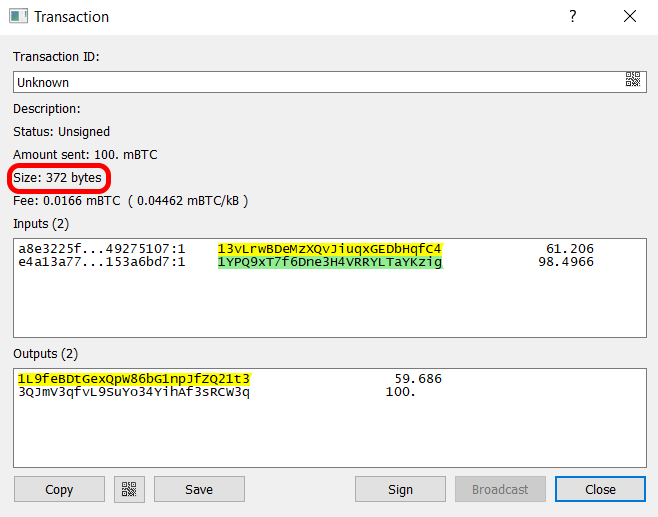
148 × 2 + 34 × 2 + 10 = 374 bytes (Electrum shows 372 bytes) - this transaction weighs so much. And it is for the weight of this transaction in bytes that we pay, but do not list the interest from the transfer amount. After the transaction is confirmed, it is sent to the Bitcoin network and falls into a transaction queue called mempool, which can be compared to a pipette - through it transactions are included in the blocks from which the entire network is built.
The queue size varies, and not all transactions immediately fall into the block. Priority is given to those who put up a larger commission - in some cases this affects the speed of the transaction. Therefore, if you decide to please a person as soon as possible with your translation, sometimes it is worth thinking about how to increase the commission amount. If both participants of the operation do not hurry, the slider can be set to a minimum - sooner or later the payment will still pass.
Before making a translation, it is advisable to look at the size of the membrane.
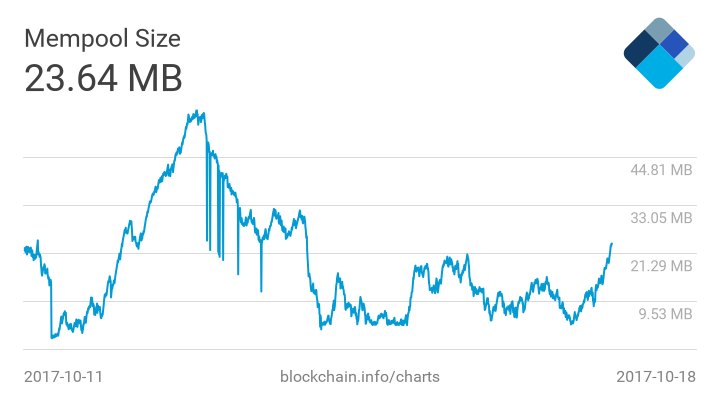
If it is practically empty, even transactions with a very small commission will pass fairly quickly, but often it's the other way around, so it's important to estimate more precisely what amount is desirable to "charge" for your transfer. To perform complex calculations, you can visit any specialized site that will tell you the optimal amount of commission, but nothing prevents you from counting everything yourself and soberly assess the situation.
Imagine that we are facing a queue of 10 000 transactions, but only 2500 of them can pass through the next block. At the same time, 9000 transactions cost with the commission of 1 Satoshi / byte. Therefore, if you are a millionaire or like to spend money, then put a commission at least 10 Satoshi / byte, please. But keep in mind that even with the commission you are charging at 2 Satoshi / bytes, your transaction will fall into the first block.
In the situation with crypto-exchange exchanges, the situation is somewhat different: users can not expose the commission by themselves, and it is already predetermined by the owners of the exchange, which can change it at their own discretion.
Who will eventually get all this commission for transfers? Miner, who will receive it along with the reward for the next block he has extracted.
Come to our , we will chat.
The article is based on materials .
Comments
Post a Comment