
Perhaps the most frequently asked question for Windows 10 users is what will happen when the free upgrade period for this OS ends. Is Microsoft going to charge a monthly fee for using its new operating system? Fortunately for users, there are quite a few signs that this will not happen. However, the reality may be somewhat different than optimistic assumptions. It should be noted that other operating systems of the software giant, except for Windows 10, will not be supported for new processors.

Reason to assume that the use of Windows 10 will not be charged a monthly fee, a lot. They were reviewed in an edited note by Ed Bott “Windows 10 subscriptions aren't happening. Here's why ”, published resource ZDNet. Of course, his conclusions are only speculative and are not based on confidence, but on analytics and studies of industry trends.
Since the software giant sees its new operating system as a service, it immediately assumes that its use implies a monthly fee. This seems to be a very logical approach, assuming that Microsoft has introduced a significant update of its operating system so that it brings the company revenue.
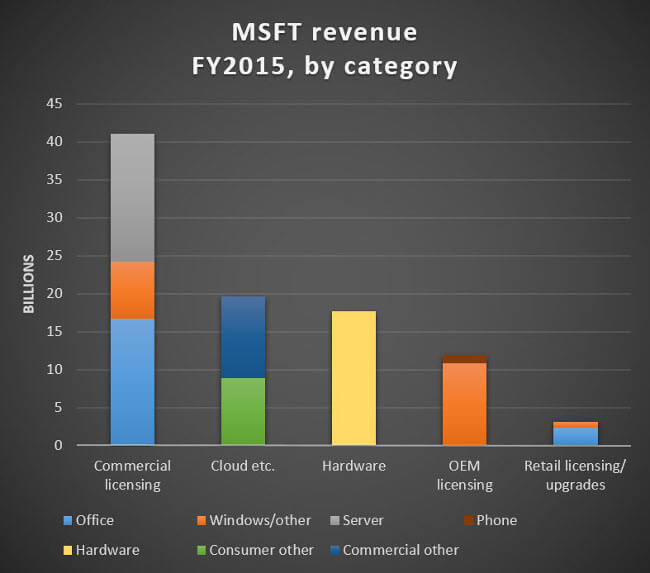
But Windows updates have never been the main source of revenue for Microsoft, which follows from the graph with which Ed Bott illustrated his note. The smallest bar of this chart reflects the role that licensing played for retail and renewal in the formation of the company's revenue in fiscal 2015.
For fiscal 2015, Microsoft's revenue was $ 93.6 billion. Nearly half of the company's revenue comes from fees for commercial licensing of server products, Microsoft Office, and upgrades to the Windows Enterprise edition.
Other significant sources of revenue for the company are cloud services (Office 365, Azure) and hardware (mainly Surface tablets and phones).
In addition, Windows 10 is not as free as it may seem at first glance. In the six months ending December 31, 2015, Microsoft received more than $ 6.2 billion from hardware manufacturers for installing Windows on their computers, which means tens of millions of licenses for new computers running Windows 10.
Over the past year, Windows retail licenses, including upgrades and academic versions, brought only 0.8 percent of Microsoft’s total revenue for the year.
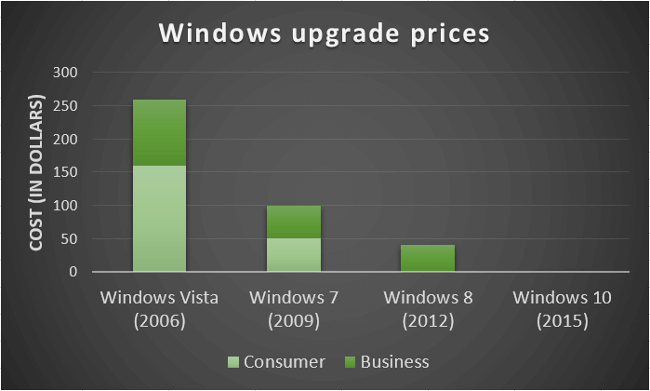
It should be noted that from version to version, the price of Windows tended to decrease, which is reflected in the schedule (green for consumers, green for business).
Windows Vista Home Premium ($ 159) and Business ($ 259). Windows 7 Home Premium ($ 50) and Pro ($ 100). Windows 8 Pro - $ 40. Windows 8.1 has become a free update. Upgrading to Windows 10 has also become free for many users.
It should be noted that Microsoft is not alone in this regard. For updates to OS X Tiger (2005) and Leopard (2007), Apple received $ 129. In 2009, the price of upgrading to Snow Leopard was reduced for many users to $ 29 from each computer. Starting in 2013, with the arrival of the Mavericks, OS X updates have become free.
On the other hand, there are successful Microsoft products used by subscription. This is primarily about Office 365, the use of which costs $ 99 per year.
Another important consumer segment for Microsoft is games that, for the six months ended December 31, 2015, brought the company more than $ 5.5 billion, almost as much as selling Windows to device manufacturers.
Xbox sales declined, but revenue from Xbox Live increased significantly - by almost 21%. Video game revenue increased even more — by 52%.
Therefore, Microsoft has more significant revenue sources than the traditional licensing of the operating system, which suggests that Windows 10 will not be among the subscription services for which fees are charged. But in any case, the decision is made by Microsoft, and what it will be, will be known only when the company reports about it to a wide audience of users of its operating systems.
No matter how many users wish to stop receiving updates, the transition of users to a new operating system seems inevitable for almost everyone except Mac users and Linux-based OSes, and the user audience is very interested in getting an idea of what the price of a new operating system will be -service
Can Windows 10, despite the assumptions considered, turn out to be a service for which a monthly fee will be charged?
The article is based on materials .
Comments
Post a Comment