
It is already known that Windows 10, which can manage even the “Internet of things”, will be released on July 29, 2015. We already know quite a lot about it, but one interesting question remains, about the version number. When Microsoft announced its new operating system last year, the surprise was not the fact that it will be, but version 9 that was missed by the company, instead of which the “tenth” version will be released immediately. Of course, Microsoft did not, and most likely will not give a direct answer to the question about the missing version number. Therefore, it remains only to speculate.

The possible reasons why Microsoft decided instead to go directly to Windows 10 instead of Windows 9 were reviewed by Jamie Lendino in the article “Why is it called Windows 10 and not Windows 9?” Published by ExtremeTech.
True Windows Numbering
You may remember that after version 3, the next number was 7. Instead of numbers, Microsoft gave its operating systems the names: 95, 98, NT, Me, 2000, Vista and others. After the company returned to a simple numbering of its operating systems.
In this case, the name of each release of Windows does not actually correspond to the real version number. For example, Windows 8.1 is actually version 6.3, and Windows 10 is 6.4. The release name has long been compared with the version number of Windows NT 4.0 that was once intended for enterprises, which was released in 1996. Windows 2000 was named NT 5.0. Thus, Windows XP was version 5.1, Windows Vista - 6.0, Windows 7 - 6.1, Windows 8 - 6.2, Windows 8.1 - 6.3.
Windows RT, which only supports Metro applications, was a separate branch of the software giant's operating systems, but it was also based on the Windows NT kernel. However, it is already in the past.
Technically, the new versions of Windows are still based on the Vista kernel and source code. Windows 10 is no exception, so it is essentially Windows 6.4. There will be more ambiguities if a version with a working number of 7.0 ever appears.
Two likely reasons why not Windows 9
ExtremeTech resource reader Benny (Benny) sent an e-mail to his editorial board informing him that the number 9 is considered unlucky in Japan. Microsoft is widely represented in Japan and for this reason could miss this number, so as not to embarrass Japanese users. Benny also wrote that Trend Micro, a Japanese company, did the same thing a few years ago, skipping version 9 of its antivirus software.
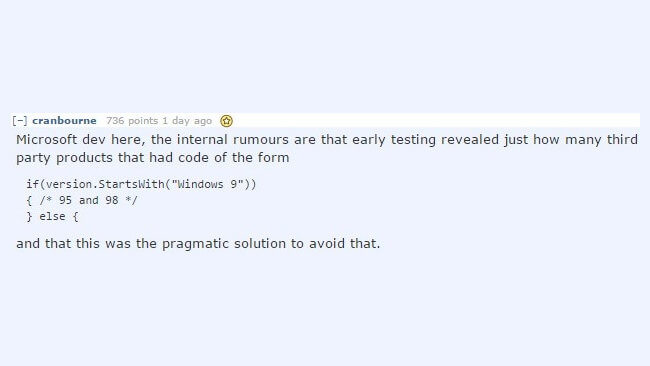
A comment appeared on Reddit as well, from which it follows that some third-party programs use a Windows version check algorithm that would accept Windows 9 as Windows 95/98.
Windows one? Already was!
So, Windows 10 is just a name. Perhaps it would be somewhat more accurate to call it Windows 9. But after all, after Vista came out Windows 7, so it makes no sense to look for some deep logic here.
This raises the second interesting question - why did Microsoft decide to call it Windows 10, and not some other way? During her presentation, it was noted that to call a Windows 9 product, which is so different from what was done before, would be wrong. It would be logical to call it Windows One, which would correspond to a whole series of names of the company's products and services - Xbox One, OneDrive, and OneNote. But, alas, Windows 1 was already in the history of the software giant, then headed by Bill Gates.
Most likely, the reason is that Microsoft would like Windows 10 not to remind users of Windows 8, which the company apparently wants to leave in the past. Microsoft has already taken a similar approach in the past, introducing Windows 7 after Vista. Users saw a difference in the very approach to the name of operating systems and might think: "This is Windows 7, and it should be very different from Vista."
Something similar happened with Apple Mac OS X. After System 1-7 they became Mac OS 8 and 9, then OS 10 (X) came in 2001, and the previous approach to numbering was discontinued. The numbers of the next versions are located after the point behind the main number 10. Windows 10 is supposed to be a single platform for devices of all form factors, and Microsoft attaches great importance to this release. And he, most likely, for a long time. The operating system will be updated with the preservation of the name-number 10. The number 10 and just suitable for the version, so different from all previous ones. Therefore, Windows 10, not 9, as previously assumed.
Why do you think Microsoft decided to call its new Windows 10 OS? Is the desire to emphasize its differences from the previous Windows only? Or one of many, but the most important reason?
The article is based on materials .
Comments
Post a Comment