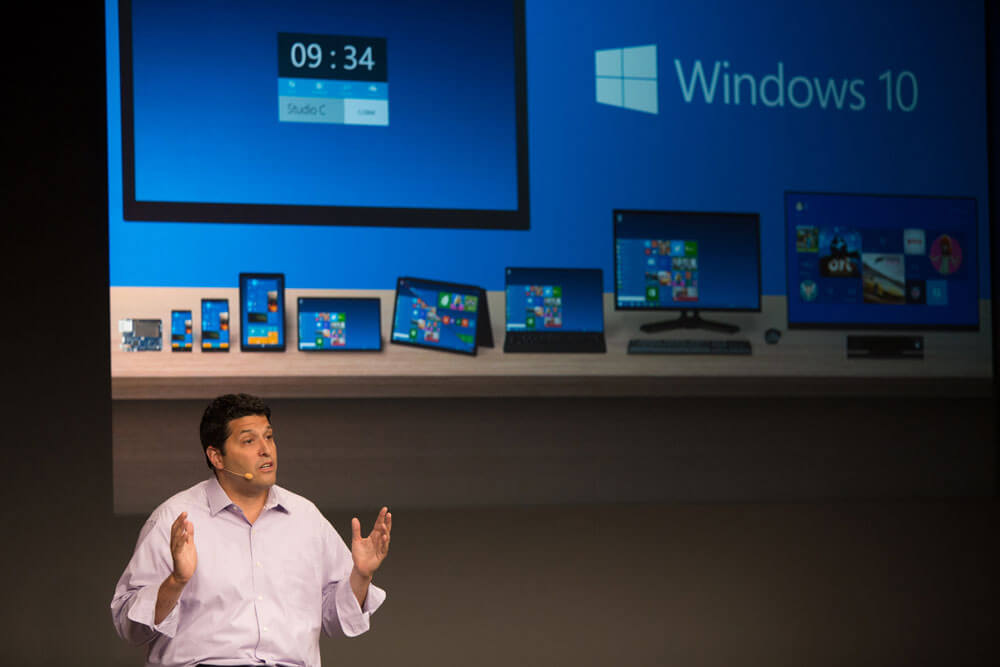
Terry Myerson, executive vice president of Microsoft, says that Windows 10 will work “on the widest range of devices”: from small Internet of Things gadgets in offices and homes to game consoles, portable tablets and phones, computer servers that run the web -sites and other software in massive data centers.
“Some of these devices have four-inch screens. Some have a screen up to 80 inches. Some people don’t have a screen at all, ”said Microsoft’s main Windows manager on Tuesday morning, opening a preliminary version of the new operating system. - Some you hold in your hands. Some use, sitting for ten feet (three meters) from them with a joystick. Some have a touchpad, some have a mouse and keyboard. Some switch between input devices. ”
It all sounds very impressive. The question is, in essence, what this means for people and enterprises interested in using the upcoming operating system - and this question is worth asking. As Myerson said, currently 1.5 billion people use Windows in one form or another. But only a few use Windows on phones or tablets, in data centers, many are switching to Linux, and very few businesses have moved to Windows 8. As Microsoft faces increasing competition in different markets - from Apple to Google - the company has to fight to keep places under the sun in a universe of computers.
According to David Johnson, an analyst at Massachusetts-based Forrester Research, only one in five enterprises currently offers Windows 8-based workers, and Windows 7 will last until 2020.
"Microsoft should give businesses a reason to switch to the new version before the crisis comes," he said, adding that companies like Apple and Google could be the main cause of this crisis.
That's why Myerson proclaimed Windows 10 as an operating system that runs everywhere. At least nominally, Apple and Google still offer different operating systems for different machines - Apple has OS X for Mac and iOS for mobile devices, Google has ChromeOS and Android. Myerson stresses that Microsoft is doing something that others do not. But what does this step really mean? Our colleagues from Wired magazine offer their point of view.
For the most part, this means that the same operating system kernel will work on wearable devices, consoles, phones, tablets, laptops, personal computers and servers — although, of course, different devices will offer different interfaces and other tools. Microsoft has been moving in this direction for the past ten years, and Windows 10 is starting to put everything together.
Myerson says that ultimately this will lead to a more efficient and reliable operating system running on a myriad of devices. He believes that the quality should be scaled, and the code used by the client will be of high quality and reliable so that it can be used on servers.
Of course, there is some sense in this. But this way of separating code from Microsoft is no longer new. Its server, desktop, mobile and game "axes" already use a lot of the same code, and indeed such things are in the order of things. Mac OS X and iOS at Apple uses a common code in part, although these are certainly different operating systems. ChromeOS and Android both work on Linux.
Myerson also says that the new Windows 10 will allow software developers to more easily create applications that will work on different devices, and the company will offer a “universal” application store that will work everywhere and everywhere. The programmer, for example, will be able to write an application that can be run on the clock, on the server, and on the laptop.
But how smooth will it be? How much will it be necessary? Microsoft hinted that the Xbox will be able to run more applications created for personal computers and laptops, but it’s not clear how this will work. And it is not clear how many developers really want to create applications for all possible devices. There are examples where the answer will be a categorical "yes", and there is - "no, of course" to the word about applications for servers and wearable electronics overnight. But as Myerson says, this is about allowing coders to make their code available in different places.
The basic idea is that the widespread adoption of Windows 10 will lead to the emergence of a large number of applications for all devices, but this is easier said than done. In fact, it is almost impossible. Microsoft has already tried to do this with Windows 8, but programmers still need to do a lot of work to make the application run on both the computer and the tablet. Perhaps Microsoft will be able to significantly simplify this task, but how much? Even if different devices use the same basic code, developers still have to make changes based on the specifics of each particular device. These are different devices, after all.
The idea is very dubious. Most developers write applications to earn money; they get paid for each specific application for a particular device. This has become a weakness of Microsoft in recent years: although Surface Tablets and the company's phones can hardly be called the worst, they simply didn’t write many applications because few people use these devices.
Myerson and company want to fix it. They need a lot of people who use different devices from Microsoft, so the company plans to load each of these devices using the rest as a springboard. Such a principle of dominoes. It's cool, but ... You know how hard people are taking drastic and significant changes. In the end, it all comes down to how each particular device works and whether it makes sense to use it.
The future of Windows 10 is not how many devices it will stand on. The future is how well each such device will work.
The article is based on materials .
Comments
Post a Comment