
Android 2.2 Froyo appeared in mid-2010. The first was updated Nexus One. In the new version, the design of the home screen has been revised: the old three-pane view, which appeared in Android 1.0, has gone into the past. It was replaced by a five-panel with a set of translucent shortcuts in the lower part, which were intended to access a set of numbers, launch a web browser and open the application screen.

The number of points on each side of the labels indicated what account the screen is currently open by the user. Previously, these capabilities were provided by third-party shells. The design of the Gallery has ceased to be flat and has gained interesting transition effects between collections of images and individual photographs.
Began to support mobile access points. Support for copying and pasting in the Gmail email application has been improved and this eliminated the platform’s most annoying flaw in the clipboard. The ability to lock the screen by password / PIN was added, targeting those users who did not like the “android” protection system “modeled on”, which is considered to be more secure.
The Android 2.2 operating system was notable primarily because Google began to break into the corporate market, where BlackBerry dominated those days. This is reflected in improvements in Exchange support.
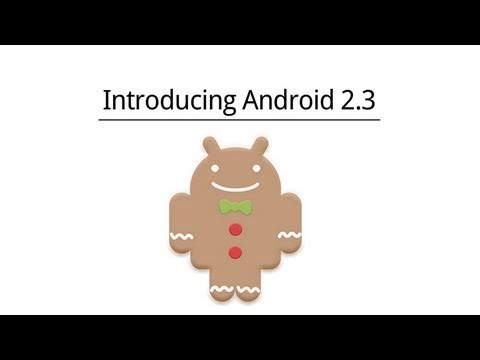
After about six months after the debut of Froyo, Google has taken another step in the development of the Nexus program, releasing Android 2.3 Gingerbread. Samsung was chosen to produce the Nexus S. The device line was derived from the successful Galaxy S family.
In many respects, the Gingerbread version (“gingerbread” in Russian) was not a very significant release. But the totality of "minor" changes brought the platform to a new level of its development. Widgets have been updated (including the famous analog clock "come from Malmo"); the desktop interface elements turned green, and the status bar began to display information in white text on a black background. Google did this, it is believed, primarily to reduce energy consumption and burn AMOLED-display. The appearance of the operating system from this only won.
Android 2.3 has offered users a whole range of new features:

Improved copy and paste accuracy. In mid-2009, Apple released iOS 3.0. Epplow's mobile platform provided a truly fantastic level of character-by-character backlighting using a virtual magnifying glass. This made it easier for the user to select text with a finger. Before the advent of Android 2.3, there was only the ability to copy the contents of the text block entirely. Often the user did not need it.
In Gingerbread, the problem was partially solved and it became possible to select individual words. There were "anchors", moving them with your finger, the user could select a piece of text. Before such opportunities were provided by the device manufacturers, in particular HTC.
Advanced keyboard. The design and colors of the keyboard have been revised. Google also expanded support for multitouch: pressing a combination of several keys by the user gave quick access to a keyboard containing additional characters.

Battery discharge. Android has advanced far in multitasking support. Too far away. Applications ran in the background and loaded the battery. This was particularly the case when the user ran poorly optimized applications. Gingerbread has a graphic panel displaying the load on the battery, which allows you to see exactly which applications and system functions and to what extent energy resources are consumed. However, the decision to remove the application and revise the intensity of its launches was made, as before, by the user himself.
Front camera support. In mid-2010, Google Talk Mobile began to support video chats. Gingerbread has provided software support for multiple cameras in one device.
New features for developers. Other new features of Gingerbread were more addressed to developers, not users. NFC hardware support was implemented in the Nexus S by integrating a special antenna into the battery cover. In the Nexus S version for the Sprint operator, a means for making payments using a mobile device Google Wallet first appeared.
Google used the Gingerbread release to break into the mobile gaming market. In this area, the search giant platform lagged significantly behind its main rival iOS at that time. The new version has provided developers with low-level access to control sound, graphics, storage and other hardware elements of the device. Thus, programmers were able to create faster code. And this paved the way for them to create games rich in intense 3D graphics. It was these games in those days that the “Android” was lacking.
It is noteworthy that in the spring of 2013 Gingerbread remained the most common "android" firmware.
Read continuation: 3.x: Honeycomb conquers tablets
The contents of the cycle "History of Android":
[1] T-Mobile G1 Autumn Debut: 1.0
[2] 1.x: Sweet Names
[3] 2.0 and 2.1: Digital cake
[4] 2.x: Many small things
[5] 3.x: Honeycomb conquers tablets
[6] 4.0: Ice cream is learning the language
[7] 4.1: First in the Jelly Bean family
[8] 4.2: Care for the visually impaired
[9] 4.3: Modular Philosophy
Based on TheVerge.com
The article is based on materials .
Comments
Post a Comment